What are the risks of the abortion pill?
Like any medication, there are some risks:
* Incomplete abortion or heavy / prolonged bleeding (sometimes requiring additional care)
* Infection
* If the pregnancy is ectopic, the medication won’t end it – and an undiagnosed ectopic pregnancy can become life-threatening. This is exactly why an ultrasound confirming the pregnancy is in the uterus is recommended before taking these medications (Source: Mayo Clinic, mayoclinic.org).
If you experience heavy bleeding, severe pain, fever, or feel faint after a medication abortion, seek medical care immediately and let them know you had a medical abortion.
What are the side effects of the abortion pill?
Commonly reported side effects:
Cramping and pain
Bleeding / clotting for 9-16 days
Nausea
Headache
Vomiting
Diarrhea
Fatigue
How intense this is can depend on how far along the pregnancy was.
What does the abortion pill do? What is it? How does it work?
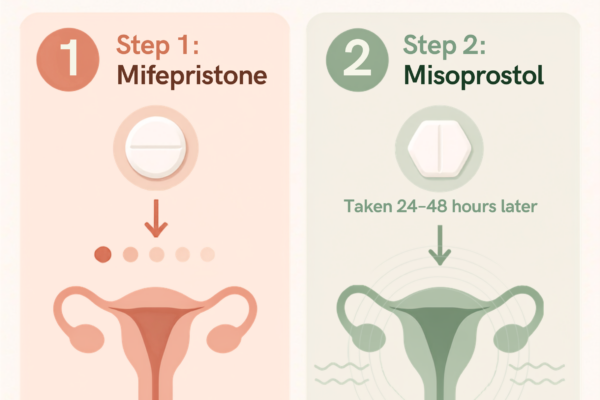
Medication abortion is a two-drug process:
Mifepristone – blocks progesterone, the hormone that sustains a pregnancy, which stops the uterus from supporting it (Source: Mayo Clinic, mayoclinic.org; KFF, kff.org).
Misoprostol – taken 24-48 hours later, causes cramping and bleeding to empty the uterus (Source: KFF, kff.org).
It’s FDA-approved for use up to 70 days (10 weeks) of pregnancy (Source: Kff, kff.org). The process plays out over hours to days and looks different for everyone. If you have more questions, that’s exactly what an appointment is for.
How does adoption work?
Adoption allows you to plan for your child’s future while choosing your own level of ongoing involvement:
Open adoption – ongoing contact
Semi-open – some contact
Closed – no ongoing contact
What’s right for you depends on your preferences and your state’s specific guidelines.
Not a true period – actual menstruation doesn’t happen during pregnancy, though light bleeding or spotting can occur in early pregnancy and is sometimes mistaken for one (Source: Cleveland Clinic, my.clevelandclinic.org). If there’s any doubt, testing is the fastest way to know for sure – and it’s free.
Can STIs affect a pregnancy?
Yes – Some untreated STIs can affect reproductive health and complicate a pregnancy (Source: CDC, cdc.gov). Early testing and treatment can significantly lower that risk.
Pregnancy officially begins when a fertilized egg attaches to the wall of the uterus. This is called implantation.
After implantation, the body starts making a hormone called hCG. This is the hormone pregnancy tests look for. It usually starts building up about 6–10 days after conception.


In early pregnancy, hCG levels double about every 2–3 days.
(Source: Cleveland Clinic, my.clevelandclinic.org).
Signs to watch for:
Missed period
Nausea or vomiting
Breast tenderness
Fatigue
Increased urination
It’s worth knowing that these symptoms can also be caused by stress, hormonal changes, or other health conditions. A pregnancy test is still your most reliable first step. Schedule yours – it’s free.
An ultrasound gathers information that matters no matter what you decide: gestational age, the location of the pregnancy, and whether it appears viable. It’s not about being told what to do – it’s about having the full picture before you decide anything.
What is a fatherhood program?
Built to help you develop real confidence and life skills to lead well as a father:
Preparing for fatherhood
Parenting education
Relationship support
Practical childcare skills
We’d genuinely love to walk through this with you. Schedule a spot.
Generally very accurate when used correctly and after a missed period – but accuracy can drop if you test too early, don’t follow the instructions, or have diluted urine (Source: Mayo Clinic, mayoclinic.org). If you get a positive result, a follow-up test or ultrasound can provide additional clarity.
How far along am I?
Pregnancy is measured in weeks from the first day of your last period – but cycles vary, so many people aren’t certain of exact dating. An ultrasound is typically the most accurate way to estimate gestational age (Source: ACOG, acog.org). This matters because it affects prenatal care planning, your options, and key health milestones. Schedule your free scan.
How often should I get tested?
At minimum, once a year if you’re sexually active – every 3-6 months if you have new or multiple partners (Source: CDC, cdc.gov/sti/testing). The only way to fully avoid STI risk is a mutually monogamous relationship where both partners have tested negative.
Is ultrasound safe?
Yes – ultrasound doesn’t use ionizing radiation like X-rays do, and there are no documented harmful effects from diagnostic ultrasound (Source: MedlinePlus / NIH, medlineplus.gov; American College of Obstetricians and Gynecologists, acog.org). It’s been standard practice in pregnancy care for decades.
However you’re feeling right now, that’s completely valid.
A positive result confirms hCG is present, but it doesn’t tell you everything. It can’t tell you how far along you are, whether things are developing, or where the pregnancy is located. An ultrasound can fill in those details. Our Team can walk you through what comes next, without a script and without pressure.
Most tests (home or clinic) can detect pregnancy around the time of a missed period. For the most accurate results, test the day after a missed period or later – testing too early is the most common reason for a false negative (Source: Mayo Clinic, mayoclinic.org).
We offer free testing – schedule your appointment today.
I’m not sure how I feel. Is that normal?
Many people feel unsure the moment they see a positive test. That’s not a red flag – it’s simply human.
Support is available for:
Parenting education
Community resources
Financial or practical support
Exploring your other options
You don’t have to figure this out on your own.
What are Pennsylvania’s abortion laws?
Pennsylvania’s own Department of Health site states abortion is available through the 23rd week of pregnancy (Source: PA Department of Health, pa.gov).
Additional requirements:
There’s a 24-hour informed consent waiting period – patients must receive counseling information at least 24 hours before the procedure (Source PA Department of health, pa.gov; 28 PA.Code 29.37).
Minors need parental consent, with a judicial bypass option available (Source: Repro Legal Helpline, reprolegalhelpline.org).
What do the parenting classes cover?
Programs designed to prepare you for pregnancy, birth, early childcare, and life skills:
Pregnancy education
Infant care basics
Parenting skills
Community resources connections
Material support
Free classes and materials, plus real community support. Schedule yours.
How can I protect my sexual health?
5 Simple Ways:
What is an ectopic pregnancy, and what are the warning signs?
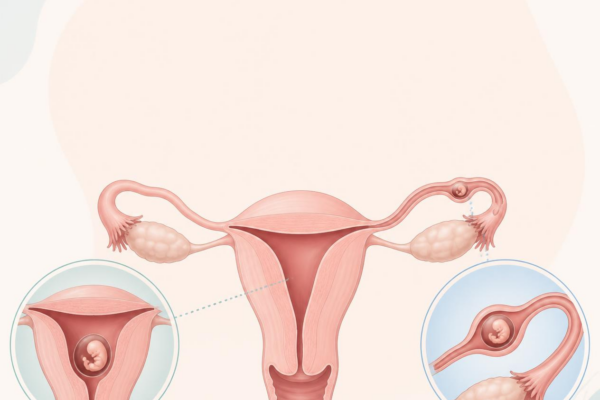
An ectopic pregnancy happens when a fertilized egg implants outside the uterus, most often in a fallopian tube – and it’s a genuine medical emergency, not something to wait out.
Warning signs to take seriously:
Sharp or severe abdominal pain
Shoulder pain
Dizziness or fainting
Vaginal bleeding
These symptoms need immediate medical attention – go to an emergency room or call 911 if you’re experiencing them (Source: Mayo Clinic, mayoclinic.org). This isn’t something to put off.
What are STI symptoms?
For women: unusual discharge/odor, pelvic pain, burning during urination, irregular bleeding.
For men: discharge from the penis, burning during urination, testicular discomfort, sores/irritation.
Many infections show no symptoms at all (Source: CDC, cdc.gov) – which is exactly why testing matters more than symptoms alone.
Should guys get tested too?
Yes, you should get tested too – routine sexual health care isn’t only for women. Testing matters even without symptoms, and every 6 months or with each new partner is the standard recommendation (Source: CDC, cdc.gov/sti/testing). Schedule your free, confidential test.
How can I support my partner?
You matter in this too, and you may need support navigating it just as much as she does – that’s not a weakness, it’s simply true.
Ways to show up:
What is a procedural (surgical) abortion?
A procedure performed in a medical setting; the specific approach depends on gestational age and individual health factors. A provider can explain exactly what to expect for your situation.
What is a limited ultrasound?
A limited obstetrical ultrasound uses sound waves (not radiation) to create images of the uterus. A trained provider performs the scan, using gel and a handheld device on the abdomen (or transvaginally if needed), and you’ll get real answers on location, estimated gestational age, and signs of viability.
I am pregnant. What are my options?
Three: parenting, adoption, or abortion. We’ll talk through all three honestly, so you can decide with real information rather than secondhand impressions.
Serving communities throughout Western Pennsylvania – Butler, Indiana, Greensburg, and Kittanning. Wherever you’re located, there’s a clinic nearby, and every visit is free and confidential.
Monday: 9:00am – 3:00pm
Tuesday: 9:00am – 7:00pm
Thursday: 9:00am – 3:00pm
Call: 877-223-7558
24/7 Hotline: 1-800-712-4357 (HELP)
Fax: 724-477-4901
Tuesday: 9:00am – 3:00pm
Thursday: 9:00am – 6:00pm
Friday: 9:00am – 3:00pm
Call: 877-223-7558
24/7 Hotline: 1-800-712-4357 (HELP)
Fax: 724-834-4511
Monday: 9:00am – 3:00pm
Tuesday: 9:00am – 7:00pm
Wednesday: 9:00am – 3:00pm
Call: (877) 223-7558
24/7 Hotline: 1-800-712-4357 (HELP)
Fax: (724) 547-0453
Tuesday: 9:00am – 5:00pm
Wednesday: 9:00am – 3:00pm
Thursday: 9:00am – 3:00pm
Call: 877-223-7558
24/7 Hotline: 1-800-712-4357 (HELP)
Fax: 724-801-8064
118 S. Church Street Butler, PA 16001
660 E. Pittsburgh St. Greensburg, PA 15601
1205 Maple St. Suite A Indiana, PA 15701
314 S. Water Street Kittanning, PA 16201